


When you're ready to establish your online presence in South Africa, understanding .co.za domain pricing isn't just about the sticker price\u2014it's about knowing exactly what you're paying for and what costs might surprise you down the road. Here's the truth: that R99 promotional rate you saw advertised? It's likely outdated, and there's more to the story than a simple annual fee.
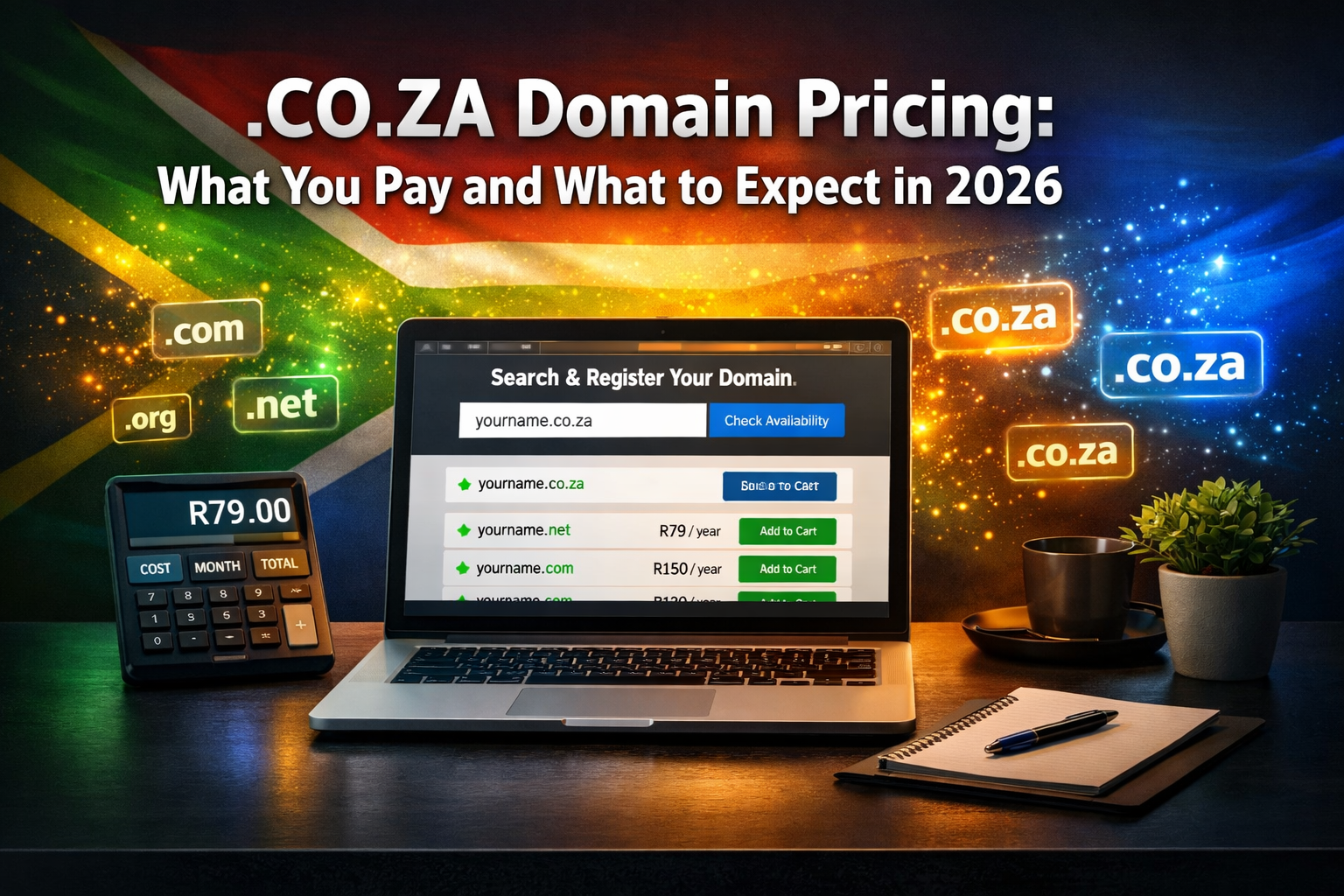
We've watched domain pricing evolve significantly over the past year, and if you're a small business owner, web designer, or IT professional managing multiple clients, you need the complete picture. This guide breaks down the real costs, hidden fees, and smart strategies for securing your .co.za domain name without overpaying or getting caught off guard by renewal surprises.
Why read this article? Because understanding .co.za domain pricing means the difference between budgeting R109 annually and suddenly facing R800+ in unexpected recovery fees when your domain accidentally expires. We'll show you exactly what to expect, how to compare registrars effectively, and why that "cheap" introductory offer might cost you more in the long run.
Key Takeaways
- .co.za registry fees increased to R109 per domain in October 2025, with retail prices now ranging from R61-R65 annually depending on your registrar
- Total cost of ownership matters more than introductory pricing\u2014compare 5-year renewal rates to avoid registrars who use loss-leader tactics
- Hidden costs include domain transfers (R310-R425), privacy protection, and redemption fees (R500-800) if your domain expires
- .co.za remains significantly cheaper than international alternatives like .com or .net, while offering stronger local SEO benefits for South African businesses
- Auto-renewal with backup payment methods is essential\u2014domain hijacking during grace periods is a real threat that can cost you your entire online presence
What Is the Current .CO.ZA Domain Pricing Structure in 2026?
Let's start with the foundation: understanding how .co.za domain pricing actually works requires knowing the difference between what the registry charges and what you ultimately pay.
The Registry Fee vs. Retail Price
The ZA Central Registry (ZACR), which operates as the contracted registry for .co.za domains under regulation by ZADNA (ZA Domain Name Authority), increased their wholesale registry fee from R99 to R109 per domain effective October 1, 2025. However, you won't pay just R109 to register your domain. Here's why:
- Registry operators (like ZACR) maintain the central database and technical infrastructure
- Accredited registrars (the companies where you actually register) add their markup for customer service, billing systems, and support
- Final retail pricing typically ranges from R109-R150 annually for .co.za domains from South African registrars
This pricing structure means the cost in South Africa you'll encounter varies by registrar, even though they're all accessing the same registry backend. Think of it like buying a car: the manufacturer sets a base price, but dealerships add their margins and services.
Why the October 2025 Price Increase Happened
The registry fee adjustment wasn't arbitrary. According to industry communications, the increase addresses several critical operational needs:
- Enhanced cybersecurity infrastructure to combat domain abuse and phishing
- Improved technical systems for faster DNS resolution and reliability
- Regulatory compliance costs associated with ZADNA oversight
- Infrastructure scaling to support the growing .co.za namespace (over 973,000 registered domains as of January 2026)
What This Means for Your Budget
If you registered or renewed your domain before October 1, 2025, you locked in the previous R99 registry rate for that registration period. Domains renewing after that date reflect the new R109 baseline, which registrars pass through to customers alongside their own pricing adjustments.
For practical budgeting purposes, expect to pay between R109-R150 annually for standard .co.za domain registration from reputable South African registrars in 2026. Some providers offer promotional introductory rates, but we'll address why those can be misleading in the next section.
How Much Does a Domain Cost Beyond the Basic Registration Fee?
The advertised domain registration price rarely tells the complete financial story. Understanding the total cost of domain ownership requires looking beyond that initial number.
The Real Cost Breakdown
When you register a domain name, here's what you're actually paying for:
- Base registry fee: R109 (wholesale cost to registrar)
- Registrar markup: R116-R131 (varies by provider, covers support and infrastructure)
But that's just the beginning. Let's examine the additional costs many businesses discover only after committing to a registrar:
Domain Privacy Protection
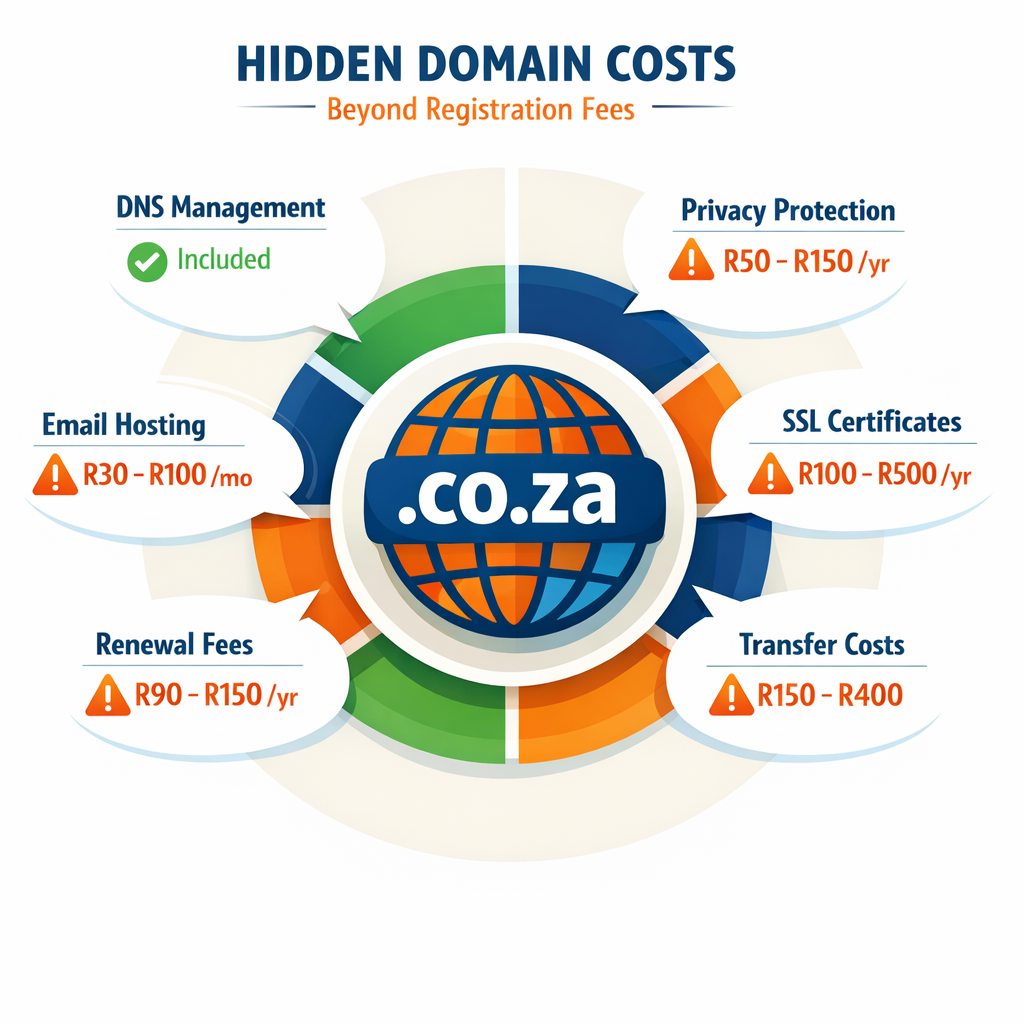
Most registrars offer WHOIS privacy protection as an optional add-on, typically costing R50-R150 annually. This service masks your personal contact information from public WHOIS databases, replacing it with the registrar's details. For south african business owners concerned about privacy, this represents an important consideration\u2014though not all registrars charge separately for this feature.
Some registrars include privacy protection free with domain registration, while others treat it as a profit center. Always clarify this before completing your purchase.
SSL Certificate Costs
While not technically part of domain registration, an SSL certificate is essential for any professional website. Many hosting providers bundle free SSL certificates with their hosting packages, but standalone SSL purchases can range from free (Let's Encrypt) to R500+ annually for premium certificates.
The connection to domain pricing? Some registrars bundle SSL with domain registration at discounted rates, while others keep these services completely separate. When comparing domain prices, factor in whether you're getting SSL included or need to purchase it separately.
Email Hosting Expenses
Want professional email addresses using your domain (like info@yourbusiness.co.za)? That's typically a separate service from domain registration. Email hosting costs vary widely:
- Basic email hosting: R50-R150 per mailbox monthly
- Business email suites (like Google Workspace or Microsoft 365): R100-R300 per user monthly
- Bundled hosting packages: Often include 5-10 email accounts with web hosting
Many businesses mistakenly assume domain registration includes email. It doesn't. Your email hosting and domains are separate services that need separate budgeting.
Domain Transfer Fees
Planning to move your domain from one registrar to another? Transfer fees typically range from R0-R109 depending on the registrar. These fees usually include a one-year registration renewal, but not always\u2014verify this before initiating a transfer.
Domain transfers become relevant when:
- Your current registrar provides poor customer service
- You're consolidating multiple domains under one provider
- You're switching to a registrar with better pricing or features
- You're moving to a provider that offers integrated web hosting and domain management
The Hidden Cost of Domain Expiration
Perhaps the most expensive "hidden" cost is what happens if your domain accidentally expires. Here's the painful financial reality:
- Grace period (typically 30 days): You can renew at standard rates, but your website and email go offline
- Redemption period (30-90 days): Recovery fees range from R500-R800 on top of renewal costs
- Deletion: After redemption, your domain becomes available for anyone to register\u2014potentially a competitor
We've seen businesses pay thousands of Rand to recover expired premium domains from opportunistic buyers who snapped them up during deletion. Auto-renewal isn't optional; it's essential protection for your online presence.
Multi-Year Registration Savings
Most registrars offer discounts for multi year registration:
- 1-year registration: Standard pricing (R109-R150)
- 2-year registration: 5-10% discount
- 5-year registration: 10-15% discount
However, calculate carefully. Some registrars offer attractive first-year rates but significantly higher renewal prices. A R150 first-year promotional rate that renews at R300 annually costs more over five years than a consistent R225 annual rate.
For a detailed breakdown of current pricing across different registrars, check our domain pricing comparison page.
How Does .CO.ZA Domain Pricing Compare to Other Domain Extensions?
Context matters when evaluating whether .co.za domain pricing represents good value. Let's compare costs and benefits across popular domain extensions.
Price Comparison: .CO.ZA vs. International Domains
Despite the recent registry fee increase, .co.za domains remain among the most affordable options globally. More importantly, they deliver superior value for businesses targeting South African customers.
The Local SEO Advantage
Here's what many businesses miss: a .co.za domain signals to search engines that your business serves South African users. Google's algorithms consider domain extension when determining local search rankings, meaning your .co.za domain gives you a competitive edge for searches like "web designer Cape Town" or "accounting services Johannesburg."
A com domain doesn't provide this geographical signal. While you can still rank for local searches with a .com, you're starting from a disadvantaged position compared to competitors using .co.za.
Trust and Recognition Factors
South African consumers have been exposed to .co.za domains for over 30 years (the co.za zone file was created in June 1993). This familiarity breeds trust. When local customers see a .co.za domain, they immediately recognize it as a South African business.
Compare this to newer domain extensions like .online, .store, or .tech, which cost R500+ annually and lack the established credibility of .co.za. For a south african business building its online presence, the combination of affordability, local SEO benefits, and consumer trust makes .co.za the logical choice.
When International Domains Make Sense
That said, .com domains serve specific purposes:
- International expansion: If you're targeting customers beyond South Africa, a .com provides global neutrality
- Brand protection: Many businesses register both .co.za and .com versions of their domain to prevent competitors from claiming the .com
- Industry expectations: Some tech startups prefer .com for perceived international credibility
The smart strategy? Register your primary .co.za domain for your main business presence, then secure the corresponding .com domain as a defensive measure. Redirect the .com to your .co.za site to capture traffic from both sources.
For more insights on choosing between these options, read our guide on the differences between co.za and com domain names.
The Premium Domain Exception
Standard .co.za domain pricing applies to available domains. However, premium domains\u2014short, memorable names or dictionary words\u2014can cost significantly more. Premium domain pricing varies wildly:
- Short domains (3-4 characters): R5,000-R50,000+
- Dictionary words: R2,000-R20,000+
- Industry-specific terms: R1,000-R10,000+
These premium prices reflect market demand, not registry fees. Someone already owns these domains and is selling them at market rates. For most small businesses, standard domain registration at R109 - R150 provides perfectly adequate branding opportunities without the premium domain cost.
What Should You Look for When Choosing a Domain Registrar?
Not all registrars offering .co.za domains provide equal value or service quality. Here's how to evaluate your options effectively.
Accreditation and Legitimacy
First, verify your chosen registrar is accredited by ZADNA to offer .co.za domain registration services. The ZA Central Registry maintains a list of accredited registrars who have met minimum criteria for technical capability and financial stability.[4]
Unaccredited resellers exist, but they operate through accredited registrars as intermediaries. This adds an extra layer between you and the actual registry, potentially complicating domain management and transfers.
Transparent Domain Pricing Structure
Red flags to watch for:
- Promotional rates without clear renewal pricing: "Register for R99!" sounds great until you discover renewals cost R350
- Hidden fees for standard features: Domain privacy, DNS management, or WHOIS updates should be included, not charged separately
- Unclear transfer policies: Some registrars make it deliberately difficult to transfer domains away
Request a complete fee schedule showing:
- Initial registration price
- Annual renewal rates (years 2-5)
- Domain transfer fees (both incoming and outgoing)
- Additional service costs (privacy protection, SSL, email)
Compare these total costs across registrars, not just the advertised first-year rate. Our domain pricing page provides transparent year-over-year comparisons to help you make informed decisions.
Technical Capabilities and DNS Management
Your domain registrar should provide:
- Full DNS control: Ability to modify A records, CNAME records, MX records, and TXT records without restrictions
- Nameserver flexibility: Option to use the registrar's nameservers or point to external hosting providers
- API access: For IT professionals managing multiple client domains, API integration streamlines domain management
- DNSSEC support: Enhanced security through DNS Security Extensions
Some budget registrars restrict DNS functionality to push customers toward their hosting services. Ensure you maintain complete control over your domain's DNS configuration regardless of where you host your website.
Customer Support Quality
Domain issues don't follow business hours. When your website goes down because of DNS misconfiguration or your domain is approaching expiration without auto-renewal working properly, you need responsive support.
Evaluate registrars based on:
- Support channels: Phone, email, live chat, ticket system
- Response times: How quickly do they acknowledge and resolve issues?
- Technical expertise: Can support staff actually solve DNS and domain configuration problems, or do they only handle billing?
- South African presence: Local support teams understand local business needs and operate in your timezone
Integration with Web Hosting and Other Services
Many businesses prefer registering domains through their web hosting provider for simplified management. This approach offers advantages:
- Single billing: One invoice for hosting and domain renewal
- Automatic DNS configuration: Hosting providers pre-configure DNS settings for their servers
- Bundled discounts: Some hosting packages include free domain registration for the first year
However, this convenience comes with considerations. If you later switch hosting providers, you'll need to either transfer your domain or update DNS settings to point to new hosting. Neither is particularly difficult, but it adds complexity.
The alternative\u2014keeping domain registration separate from hosting\u2014provides maximum flexibility but requires managing relationships with multiple providers.
For businesses just starting out, we typically recommend bundling domain and hosting initially for simplicity, then evaluating separation as your technical sophistication grows. Our web hosting services include domain registration with transparent pricing and no lock-in requirements.
Payment Methods and Currency
Since you're paying for a South African domain, registrars offering ZAR-based billing eliminate currency exchange volatility and foreign transaction fees. International registrars charging in USD or EUR expose you to exchange rate fluctuations that can significantly impact renewal costs over time.
Verify accepted payment methods include:
- South African bank transfers (EFT)
- Local credit/debit cards
- Instant EFT services
- Recurring payment options for auto-renewal
Domain Portability and Transfer Policies
You should always be able to transfer your domain to another registrar if you're unsatisfied with service. Legitimate registrars make this process straightforward:
- Provide EPP/authorization codes promptly when requested
- Don't charge excessive transfer-out fees
- Don't impose arbitrary transfer restrictions beyond ICANN's standard 60-day lock for new registrations
If a registrar makes domain transfers difficult, that's a clear signal to choose a different provider. Your domain is your property; any registrar treating it otherwise doesn't deserve your business.
How Can You Minimize Domain Costs While Maximizing Value?
Smart domain management isn't about finding the absolute cheapest option\u2014it's about optimizing value while avoiding unnecessary expenses.
Strategic Multi-Year Registration
Locking in current rates through multi year registration protects you from future price increases. When ZACR raised registry fees by 10% in October 2025, businesses with multi-year registrations maintained their previous rates until renewal.
Consider this scenario:
- Annual registration at R109: Exposed to potential price increases every year
- 5-year registration at R545/year: Total cost, locked in for five years regardless of future registry fee changes
The savings compound if registry fees continue increasing. Even a modest 5% annual increase over five years makes multi-year registration significantly more economical.
Bundling Domain with Hosting Packages
Many hosting providers offer free domain registration with annual hosting packages. A typical shared hosting plan costing R1,200-R1,800 annually might include:
- Free .co.za domain registration (R240 value)
- SSL certificate (R300-R500 value)
- Professional email addresses (R600+ value)
- Website hosting with adequate resources
The combined value often exceeds R2,000 for a package costing under R2,000. However, read the fine print: "free" domains typically require maintaining the hosting package. Cancel hosting, and you'll pay standard renewal rates for the domain.
This bundling strategy works well for businesses needing both hosting and domain registration anyway. It's less attractive if you're only seeking domain registration or already have hosting elsewhere.
Avoiding Unnecessary Add-Ons
Registrars profit from upselling services you may not need:
- Domain privacy for .co.za: Less critical than for .com domains, since .co.za WHOIS policies already limit public data exposure[6]
- Premium DNS services: Standard DNS works perfectly for most small business websites
- Website builder tools: Often redundant if you're using WordPress or working with a web designer
- Email services: Compare registrar email pricing against standalone email hosting providers\u2014you'll often find better value elsewhere
Evaluate each add-on critically: Does this solve a real problem for your business, or is it just increasing the registrar's profit margin?
Setting Up Auto-Renewal Properly
Domain expiration is expensive and embarrassing. Auto-renewal prevents both, but only if configured correctly:
- Enable auto-renewal immediately upon registration
- Add backup payment methods in case your primary card expires or reaches its limit
- Verify contact email addresses so you receive renewal reminders
- Set calendar reminders 60 days before renewal to review pricing and confirm auto-renewal is active
We've seen businesses lose valuable domains because auto-renewal failed due to an expired credit card. The cost of recovering an expired domain through the redemption period (R500-R800 plus standard renewal fees) far exceeds the effort of maintaining current payment information.
Monitoring Domain Renewal Prices
Your registrar can change renewal prices with notice (typically 30-60 days). Monitor these changes and be prepared to transfer domains if renewal rates become uncompetitive.
For example, if your current registrar increases .co.za renewals from R240 to R350 while competitors maintain R240 pricing, transferring your domain saves R110 annually. Multiply that across multiple domains, and the savings justify the transfer effort.
Leveraging Promotional Periods Wisely
Registrars frequently offer promotional pricing for new customers:
- First-year .co.za registration at R150-R180
- Free domain privacy for the first year
- Discounted SSL certificates with domain purchase
These promotions provide genuine value if you understand the long-term costs. Calculate the total 5-year cost including standard renewal rates, not just the promotional first-year price.
A R150 promotional rate that renews at R300 costs R1,350 over five years. A consistent R225 annual rate costs R1,125 over the same period. The promotion actually costs more despite the attractive initial price.
Consolidating Domains Under One Registrar
Managing multiple domains across different registrars creates administrative overhead and increases the risk of missed renewals. Consolidating domains under a single registrar provides:
- Simplified billing and payment management
- Bulk renewal discounts (some registrars offer volume pricing)
- Easier DNS management across your domain portfolio
- Reduced risk of missing renewal deadlines
However, don't consolidate purely for convenience if it means accepting inferior service or higher pricing. The right registrar should offer both competitive pricing and quality service.
For businesses managing client domains, consider our reseller hosting with WHMCS solution, which provides white-label domain registration capabilities with wholesale pricing.
What Are the Long-Term Considerations for Domain Ownership?
Domain registration isn't a one-time transaction\u2014it's an ongoing relationship that requires strategic thinking about your business's future.
Understanding the Domain Lifecycle
Every domain progresses through distinct lifecycle stages, each with financial implications:
- Initial registration: Standard pricing applies (R109-R150 for .co.za)
- Active status: Annual renewals at standard rates, typically with slight increases over time
- Grace period (upon expiration): 30-day window to renew at standard rates, but services go offline
- Redemption period: 30-90 days where recovery requires additional fees (R500-R800)
- Pending deletion: Final period before domain becomes available for public registration
- Available: Domain released for anyone to register
Understanding the lifecycle helps you avoid the expensive redemption period. Set multiple renewal reminders and maintain active auto-renewal to keep your domain in the "active status" stage indefinitely.
Planning for Business Growth
Your domain strategy should accommodate business evolution:
- Multiple domain names: As you expand services or target new markets, you'll need additional domains
- Domain variations: Registering common misspellings or alternative extensions protects your brand
- Geographic expansion: If you expand beyond South Africa, you might need country-specific domains (.com.au, .co.uk, etc.)
Budget for domain portfolio growth. A business starting with one .co.za domain might need 5-10 domains within five years to protect brand variations and support new initiatives.
Domain as Brand Asset
Your domain represents significant brand equity. Consider:
- Memorability: Short, brandable domains become more valuable as your business grows
- SEO value: Aged domains with clean histories rank better than new registrations
- Customer recognition: Changing domains confuses customers and damages SEO
This brand value means choosing the right domain initially matters more than saving R50 on registration. A memorable .co.za domain that perfectly matches your business name justifies paying standard rates rather than settling for a less ideal domain just because it's cheaper.
Security and Domain Protection
Domain security deserves ongoing attention:
- Registry lock: Prevents unauthorized transfers
- Two-factor authentication: Protects registrar account access
- Domain monitoring: Alerts you to unauthorized changes
- DNSSEC: Prevents DNS spoofing and cache poisoning
These security features are often included with domain registration but require activation. Don't assume they're enabled by default\u2014verify and activate all available security measures.
Exit Strategy and Domain Transfers
Business circumstances change. You might:
- Sell your business (domain transfers to new owner)
- Merge with another company (domain consolidation)
- Change registrars for better service or pricing
- Rebrand and need different domains
Plan for these scenarios by:
- Maintaining accurate WHOIS contact information
- Documenting domain ownership clearly in business records
- Understanding your registrar's transfer procedures
- Keeping domains unlocked from registrar-specific services that complicate transfers
Regulatory Compliance and ZADNA Requirements
The .za Domain Name Authority (ZADNA) regulates .co.za domains under the Electronic Communications and Transactions Act, 2002. While compliance requirements for standard .co.za registrations are minimal, be aware of:
- Accurate WHOIS information requirements
- Dispute resolution procedures if domain ownership is challenged
- Registrar accreditation standards that protect your interests
- Charter provisions governing .co.za namespace usage
Reputable registrars handle compliance on your behalf, but understanding these regulatory foundations helps you recognize when a registrar isn't meeting their obligations.
For comprehensive guidance on domain fundamentals, see our article on what is a domain.
You might also like our guides on point of sale systems in South Africa, website maintenance costs in South Africa and which companies can benefit from a .africa domain name.
You might also like our guides on WordPress hosting South Africa from r129/mo — free domain & migration and domain privacy and protection.
You may also find our guide on business email hosting in South Africa from r69/mo — free setup.
For more detail, see Plesk reseller hosting South Africa from r280/mo — free WHMCS add-on.


