


When you're building an online store in South Africa, one of your first and most important decisions is choosing the right domain name. While you might be tempted to go with a generic .com domain, there's a compelling case for using a co.za domain for ecommerce stores in South Africa\u2014and it goes far beyond simple geography. The domain you choose becomes your digital storefront, your brand identity, and a powerful signal to both customers and search engines about who you serve and where you operate.
In this comprehensive guide, we'll walk you through everything you need to know about leveraging a .co.za domain for your South African ecommerce business. You'll discover why local domains matter for building trust, how they impact your visibility in local search results, and the practical steps to register and manage your domain effectively. Whether you're launching your first online store or considering a rebrand for an existing business, this article will help you make an informed decision that supports your long-term growth.
Key Takeaways
- .co.za domains provide stronger local SEO performance and help your ecommerce store rank higher in South African search results, directly reaching your target audience
- South African customers trust .co.za domains more than generic extensions, with the local domain extension signaling legitimacy and commitment to the South African market
- Domain registration costs are affordable at R109 per year, the same price to register and to renew, making it accessible for businesses of all sizes
- Free value-added services like DNS hosting, domain privacy protection, and nameserver management typically come included with .co.za registration
- The .za Domain Name Authority (ZADNA) provides regulatory oversight and security features like DNSSEC to protect your brand and customers
What Is a .co.za Domain and Why Does It Matter for Ecommerce?
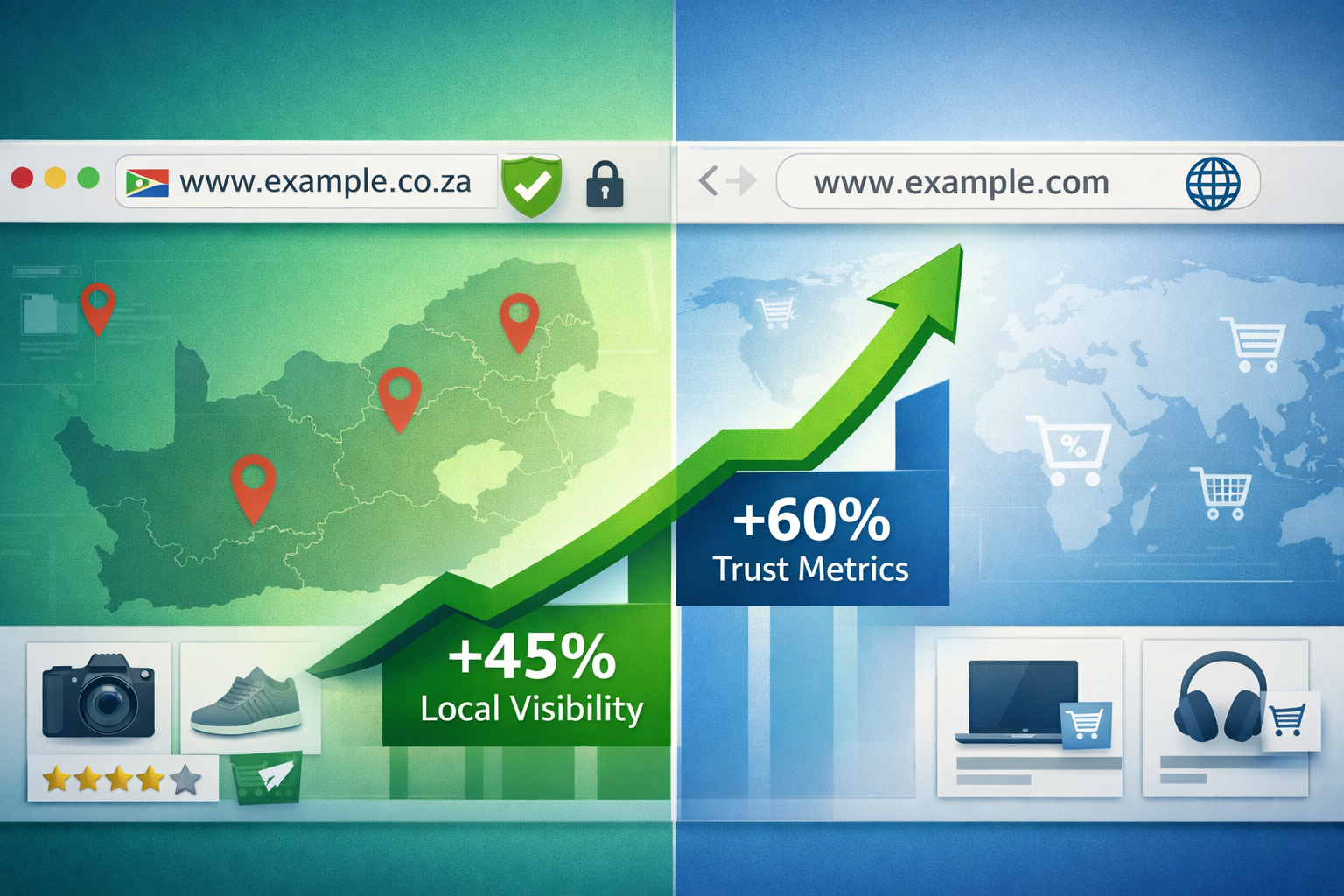
A .co.za domain is South Africa's country code top-level domain (ccTLD) specifically designated for commercial entities. The ".co" stands for commercial, while ".za" represents South Africa's ISO country code. Unlike generic top-level domains like .com or .net, a .co.za domain immediately identifies your business as operating within the South African market.
For ecommerce businesses, this local domain extension serves multiple strategic purposes. First, it acts as a trust signal to South African customers who are increasingly cautious about online shopping security. When shoppers see a .co.za domain, they recognize it as a locally registered business subject to South African regulations and consumer protection laws. Second, search engines use domain extensions as one of many factors when determining geographic relevance, which means a .co.za domain can help your online store appear more prominently in local search results.
The .co.za domain has been South Africa's most recognized and trusted commercial domain extension for decades, providing strong local SEO performance and wide brand recognition for businesses seeking a professional and locally relevant online identity [1]. With South African online sales increasing 66% from 2019 to 2020, reaching over $1.8 billion (ZAR30 billion), establishing a strong online presence with the right domain has never been more critical for ecommerce success [5].
How Does a .co.za Domain Help Build Trust with South African Customers?
Trust is the foundation of successful ecommerce, and your domain name plays a surprisingly significant role in establishing that trust. South African consumers have become more sophisticated about online shopping, and they look for signals that indicate a business is legitimate, local, and accountable.
A .co.za domain immediately communicates that your business has gone through a proper domain registration process with an accredited registrar operating under ZADNA oversight. This regulatory framework, established in 2002, ensures that domains are registered legitimately and that there are proper dispute resolution mechanisms in place [4]. For customers, this means they're dealing with a business that can be traced and held accountable under South African law.
Beyond regulatory compliance, the .co.za extension signals cultural and market understanding. South African customers want to know that you understand their specific needs, payment preferences, delivery challenges, and local context. When they see a .co.za domain, they perceive your business as being "one of them" rather than a foreign entity that might not understand local expectations or provide adequate customer support during South African business hours.
This trust factor becomes even more important when you consider that South Africans are increasingly concerned about online fraud and payment security. A local domain combined with other trust indicators like SSL certificates, local payment options, and South African contact information creates a comprehensive trust profile that can significantly improve your conversion rates. For more insights on establishing trust online, explore our guide on professional website design for South African businesses.
Why Is Local SEO Important for Your South African Online Store?
Search engine optimization (SEO) for ecommerce isn't just about ranking for product keywords\u2014it's about being found by the right customers at the right time. For businesses selling online in South Africa, local SEO provides a competitive advantage that can dramatically impact your bottom line.
Search engines like Google use hundreds of ranking factors to determine which websites to show for any given query. When someone in South Africa searches for products or services, Google's algorithms attempt to provide the most relevant results based on the searcher's location. A .co.za domain serves as a strong geographic signal that tells search engines your business is relevant to South African users [8].
This geographic relevance becomes particularly powerful when combined with other local SEO factors. When your .co.za domain is paired with South African business information, local hosting, content that references South African cities and regions, and backlinks from other South African websites, you create a comprehensive local SEO profile that's difficult for international competitors to match.
The practical impact of this local search advantage can be substantial. South African shoppers searching for products often include location-specific terms like "buy [product] in South Africa" or "South African online store for [category]." Your .co.za domain helps you rank for these valuable local search queries, capturing customers who are specifically looking for local suppliers. Additionally, the co.za domain offers better visibility in Google's local pack results and map listings when you're targeting specific South African cities or regions.
Consider that clothing and apparel are among the top ecommerce product categories in South Africa after data and airtime [5]. If you're running an online clothing store, competing against international fashion retailers with .com domains becomes significantly easier when you have the local SEO advantage that a .co.za domain provides, especially when targeting South African customers who prefer local suppliers for faster delivery and easier returns.
What Are the Key Benefits of Using a .co.za Domain for Ecommerce Stores in South Africa?
Choosing a co.za domain for ecommerce stores in South Africa delivers multiple strategic advantages that extend beyond simple web address functionality. Understanding these benefits helps you make an informed decision about your online identity and digital strategy.
Enhanced Local Market Credibility: The .co.za extension instantly positions your ecommerce business as a legitimate South African enterprise. This local credibility is particularly valuable in categories where customers prefer buying from local businesses due to concerns about delivery times, return policies, and customer service accessibility. South African consumers recognize .co.za as the standard for commercial businesses in South Africa, creating immediate familiarity and comfort.
Improved Search Engine Rankings: Your domain extension influences how search engines categorize and rank your website for geographic queries. A .co.za domain signals to search engines that your content and offerings are specifically relevant to South African users, improving your visibility in local search results. This SEO advantage compounds over time as you build content, earn backlinks, and establish authority within the South African market.
Better Brand Protection: Securing your .co.za domain protects your brand within the South African market and prevents competitors from registering similar domains that could confuse customers or dilute your brand identity. Given the relatively low registration fee of R109 per year, registering your .co.za domain is an affordable insurance policy against brand confusion and competitive threats.
Increased Conversion Rates: Trust directly impacts conversion rates in ecommerce. When South African shoppers land on your website and see a .co.za domain, they're more likely to complete purchases because they perceive lower risk. This trust factor becomes especially important for first-time visitors who haven't yet experienced your customer service or product quality.
Alignment with Local Payment Systems: While your domain doesn't directly control payment processing, a .co.za domain aligns with the expectation that you'll offer South African payment options like EFT, SnapScan, Zapper, or local credit card processing. This alignment of expectations creates a smoother customer journey from discovery to purchase.
Regulatory Compliance Signaling: Operating an ecommerce business in South Africa comes with specific regulatory requirements around consumer protection, privacy, and electronic transactions. A .co.za domain signals that you're operating within this regulatory framework, which provides additional reassurance to cautious online shoppers.
For businesses looking to establish a comprehensive online presence, pairing your .co.za domain with reliable web hosting services ensures your ecommerce store performs optimally for South African customers.
How Do You Register a .co.za Domain for Your Ecommerce Business?
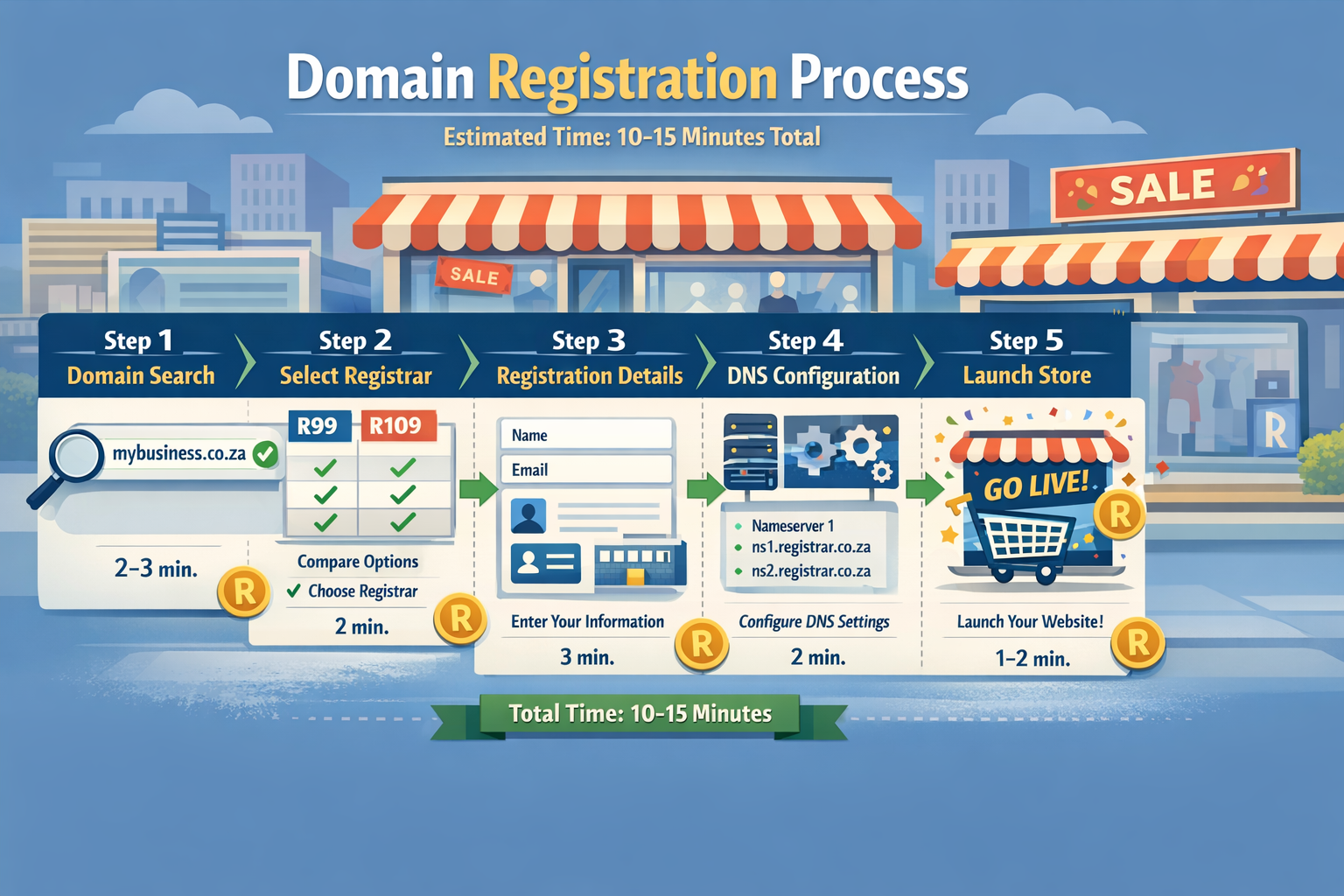
The registration process for a .co.za domain is straightforward and can typically be completed in 10-15 minutes [2]. Understanding the steps involved helps you prepare the necessary information and make informed decisions about registrar selection and additional services.
Step 1: Choose Your Domain Name: Before you can register, you need to select an available domain name that represents your brand effectively. Your domain should be memorable, easy to spell, and relevant to your products or services. Consider including keywords that describe what you sell, but prioritize brandability over exact-match keywords. Use the domain search tools provided by registrars to check availability and explore alternatives if your first choice is already taken.
Step 2: Select an Accredited Registrar: You must register your .co.za domain through an accredited domain registrar that operates under ZADNA's regulatory framework. South Africa has several reputable registrars, including both local specialists and international providers with South African operations. When evaluating registrars, consider factors like pricing transparency, customer support quality, included services, and management interface usability. For a seamless experience, you can register your .co.za domain through trusted providers that offer comprehensive support.
Step 3: Provide Registration Information: During the registration process, you'll need to provide contact information including your name or business name, physical address, email address, and phone number. This information becomes part of the public WHOIS database unless you opt for domain privacy protection services, which many registrars offer as a free or low-cost add-on.
Step 4: Configure DNS Settings: After registration, you'll need to configure your domain's DNS (Domain Name System) settings to point to your web hosting provider. Most registrars provide free DNS hosting and nameserver management as part of the registration package [1]. If you're using a website builder or ecommerce platform, they'll typically provide specific nameserver addresses to enter in your domain management panel.
Step 5: Set Up Email and Additional Services: Once your domain is active, you can configure professional email addresses using your domain name (like sales@yourbusiness.co.za), which significantly enhances your professional image. Many hosting providers include email hosting with their packages, or you can use specialized email hosting services for more advanced features.
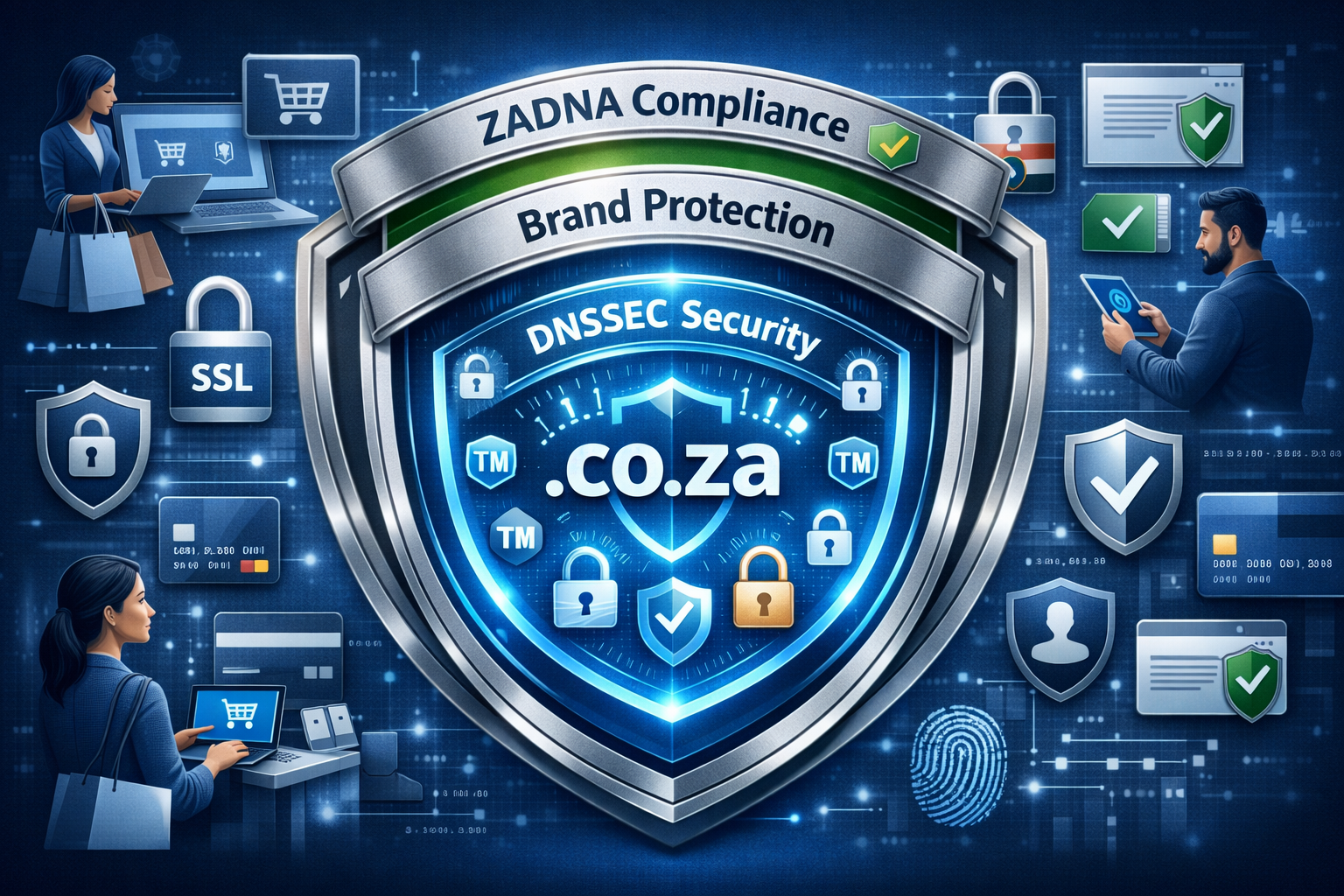
The .za domain has adopted DNSSEC (Domain Name System Security Extensions) protocol to help safeguard website authenticity and customer privacy, providing an extra layer of online safety against counterfeit or abusive domain names [7]. Ensure your registrar supports DNSSEC if security is a priority for your ecommerce operation.
What Should You Consider When Choosing a Domain Name for Your Online Store?
Choosing a domain name is one of the most permanent decisions you'll make for your ecommerce business. While you can change it later, doing so requires significant effort and can result in lost traffic and brand recognition. Approaching this decision strategically ensures you select a name that supports your long-term business goals.
Brandability vs. Keywords: There's an ongoing debate about whether domain names should prioritize brand identity or include descriptive keywords. For ecommerce stores, the ideal approach often combines both elements. A domain like "CapeTownShoes.co.za" includes both a geographic identifier and a product category, making it clear what you sell while maintaining some brand identity. However, purely descriptive domains can limit your ability to expand into new product categories later.
Length and Memorability: Shorter domains are generally easier to remember, type, and share. Aim for domain names under 15 characters if possible, though don't sacrifice clarity for brevity. Avoid complex spellings, numbers, or hyphens that might confuse customers or lead to typing errors. Your perfect domain name should be something customers can easily remember after hearing it once and can spell correctly without seeing it written down.
Pronunciation and Spelling: Test your potential domain name by saying it out loud and asking others to spell it. If people consistently misspell or mispronounce your domain, you'll face ongoing challenges with word-of-mouth marketing and verbal communication. This is particularly important if you plan to advertise on radio or discuss your business in person.
Future Expansion Considerations: Consider where your business might grow in the future. A domain like "JohannesburgElectronics.co.za" works well if you plan to remain focused on electronics in Johannesburg, but it could become limiting if you later want to expand into other product categories or serve customers nationwide. Choose a domain that provides room for growth without being so generic that it lacks identity.
Trademark and Legal Issues: Before finalizing your domain choice, conduct a trademark search to ensure you're not infringing on existing intellectual property rights. Registering a domain that conflicts with an established trademark can lead to legal disputes and potentially losing the domain. Check the Companies and Intellectual Property Commission (CIPC) database and conduct general web searches to identify potential conflicts.
Domain Availability Across Extensions: While your primary focus should be securing your .co.za domain, check whether the same name is available as a .com domain and other relevant extensions. Even if you primarily use your .co.za domain, registering multiple extensions prevents competitors from creating confusion and allows you to redirect traffic from alternative domains to your main site.
For entrepreneurs working with limited budgets, our guide on starting a business with R1000 in South Africa provides practical advice on prioritizing essential investments like domain registration.
How Much Does a .co.za Domain Cost and What's Included?
Understanding the complete cost structure of .co.za domain ownership helps you budget appropriately and avoid unexpected expenses. Domain pricing in South Africa is competitive and transparent, with most registrars offering similar base rates and various value-added services.
Initial Registration Fees: .co.za domains are registered at R109 per year through accredited registrars. Some registrars offer promotional pricing for first-year registration, with rates occasionally dropping to R49 or even lower during special promotions. However, it's important to check the renewal rate, as promotional pricing typically only applies to the first year.
Renewal Costs: Standard renewal fees for .co.za domains typically range around R109 annually [1]. These renewal costs remain relatively stable year-over-year, making domain ownership a predictable ongoing expense. Most registrars offer multi-year registration options that can lock in current pricing and ensure you don't accidentally lose your domain due to forgotten renewals.
Transfer Fees: If you decide to move your domain from one registrar to another, transfer fees vary by provider. Many registrars offer free domain transfers or include a one-year renewal with the transfer fee, effectively making the transfer cost-neutral [1]. Domain transfers typically take 5-7 days to complete and require an authorization code from your current registrar.
Value-Added Services: Most .co.za domain registrations include several free services that add significant value. These typically include free DNS hosting, which allows you to manage your domain's technical settings; nameserver management for pointing your domain to your web hosting; domain parking, which displays a placeholder page while you're building your site; and basic DNS record management for configuring email and other services [1].
Optional Premium Services: Beyond the basic registration, registrars offer various premium services at additional cost. Domain privacy protection (typically R50-R150 per year) hides your personal contact information from the public WHOIS database, reducing spam and protecting your privacy. Premium DNS services offer enhanced performance and security features. SSL certificates, while often included with web hosting packages, can also be purchased separately to secure your domain with HTTPS encryption.
Bundled Packages: Many providers offer bundled packages that combine domain registration with web hosting, email hosting, and website builder tools at discounted rates. For ecommerce businesses, these bundles can provide significant value and simplify management by consolidating services with a single provider. Explore WordPress hosting options that include free domain registration as part of comprehensive hosting packages.
The relatively low cost of domain registration makes it accessible for businesses of all sizes, from solo entrepreneurs to established enterprises. Given that your domain becomes a critical business asset, the annual investment of R109 represents exceptional value for the benefits it provides in terms of brand identity, customer trust, and search engine visibility.
What Technical Considerations Should You Know About .co.za Domains?
While domain registration itself is straightforward, understanding the technical aspects of domain management helps you avoid common pitfalls and ensures your ecommerce store operates smoothly. You don't need to become a technical expert, but familiarity with key concepts empowers you to make informed decisions and troubleshoot issues effectively.
DNS Management and Nameservers: The Domain Name System (DNS) is the internet's addressing system that translates human-readable domain names into IP addresses that computers use to locate websites. When you register your domain, you'll need to configure nameservers that tell the DNS where to find your website. Most web hosting providers give you specific nameserver addresses to enter in your domain management panel. Changes to nameservers typically take 24-48 hours to propagate globally, though they often work much faster.
DNS Records and Configuration: Beyond nameservers, you'll work with various DNS record types for different purposes. A records point your domain to specific IP addresses for your website. MX records direct email to your mail servers. TXT records verify domain ownership for services like Google Workspace or email authentication protocols. CNAME records create aliases or subdomains. Most registrars provide intuitive interfaces for managing these records without requiring deep technical knowledge.
Domain Security with DNSSEC: The .za domain has implemented DNSSEC (Domain Name System Security Extensions) to enhance security [7]. DNSSEC adds cryptographic signatures to DNS records, helping prevent DNS spoofing and cache poisoning attacks that could redirect your customers to fraudulent websites. While DNSSEC configuration is typically handled by your registrar or hosting provider, understanding that this protection exists provides peace of mind for your ecommerce operations.
Domain Privacy Protection: When you register a domain, your contact information becomes part of the public WHOIS database, which anyone can search. Domain privacy services replace your personal information with the registrar's contact details, protecting you from spam, unwanted solicitation, and potential identity theft. For ecommerce businesses, privacy protection is particularly valuable as it prevents competitors from easily accessing your contact information.
SSL Certificates and HTTPS: While technically separate from your domain registration, SSL certificates work with your domain to encrypt data transmitted between your website and customers. For ecommerce stores handling sensitive information like payment details, SSL certificates are essential. Most modern web hosting providers include free SSL certificates, and browsers now mark sites without HTTPS as "not secure," which can severely damage customer trust and conversion rates.
Subdomain Strategy: Your .co.za domain can support unlimited subdomains (like shop.yourbusiness.co.za or blog.yourbusiness.co.za), allowing you to organize different sections of your online presence. Subdomains can be useful for separating your main ecommerce store from content marketing efforts, customer support portals, or regional variations of your site.
Email Configuration: Professional email addresses using your domain (like info@yourbusiness.co.za) significantly enhance credibility. Configuring email requires setting up MX records and potentially SPF, DKIM, and DMARC records for email authentication and deliverability. Many hosting providers offer simplified email setup wizards that handle these technical details automatically.
For businesses building ecommerce stores on WordPress, our guide to WordPress hosting covers the technical integration between domains, hosting, and ecommerce platforms.
How Does a .co.za Domain Compare to .com and Other Extensions?
When establishing your ecommerce presence, you'll need to decide which domain extensions to prioritize. While .co.za offers significant advantages for South African businesses, understanding how it compares to alternatives helps you develop a comprehensive domain strategy.
Geographic Targeting: The primary distinction between .co.za and .com domains lies in geographic targeting. A .co.za domain explicitly signals that your business operates in and serves the South African market, while a .com domain (a generic top-level domain) suggests a more international or global focus [1]. For ecommerce stores primarily serving South African customers, the .co.za extension provides stronger local relevance and better local SEO performance.
Trust and Recognition: Within South Africa, .co.za domains carry stronger trust signals than .com domains for local businesses. South African consumers have been conditioned over decades to recognize .co.za as the standard for legitimate South African commercial entities. A com domain might raise questions about whether the business is actually local or if it's an international company without proper South African operations.
SEO Implications: Search engines use domain extensions as one factor in determining geographic relevance. A .co.za domain helps your website rank better for searches conducted by users in South Africa and for queries with local intent. While a .com domain can certainly rank well in South African search results, it requires additional signals (like local hosting, South African business information, and local backlinks) to compete with the inherent geographic advantage of a .co.za domain.
International Expansion Considerations: If you plan to expand beyond South Africa and serve international markets, a .com domain provides more flexibility and global recognition. However, this doesn't mean you must choose between them. Many successful South African ecommerce businesses adopt a multi-domain strategy, using their .co.za domain as their primary South African presence while also registering the .com version to protect their brand and potentially serve international customers.
Other South African Extensions: Beyond .co.za, South Africa offers several other domain extensions including .org.za (for organizations), .net.za (for network infrastructure), and .web.za (for web-related services). The .za Domain Name Authority manages these through a Shared Registry System (SRS) that allows single accreditation to provide access to multiple extensions [4]. For ecommerce purposes, .co.za remains the most appropriate and recognized option.
City-Specific TLDs: South Africa also offers geographic TLDs like .joburg, .durban, and .capetown for businesses wanting to emphasize their connection to specific cities [8]. These can be valuable for businesses with strong local focus, but they lack the broad recognition and trust that .co.za commands across the entire country.
Domain Portfolio Strategy: Rather than viewing domain extensions as an either-or decision, consider them as complementary assets in your digital portfolio. Register your primary .co.za domain for your main South African operations, secure the .com version to protect your brand internationally, and potentially add city-specific or alternative extensions if they align with your marketing strategy. This multi-domain approach prevents competitors from registering similar domains and allows you to redirect all variations to your primary site.
For insights on how domain choices impact your overall digital presence, explore our article on the role of .co.za domains in South Africa's digital economy.
What Are Common Mistakes to Avoid When Registering Your Ecommerce Domain?
Learning from others' mistakes can save you significant time, money, and frustration. Many ecommerce businesses make predictable errors during domain registration and management that create problems later. Avoiding these pitfalls ensures your domain serves as a strong foundation for your online business.
Neglecting to Renew Your Domain: Perhaps the most catastrophic mistake is allowing your domain to expire. When a domain expires, your website goes offline, email stops working, and you risk losing the domain entirely if someone else registers it. Set up automatic renewal with your registrar and ensure your payment information stays current. Most registrars send renewal reminders, but don't rely solely on these\u2014add domain renewal dates to your business calendar.
Using Personal Email for Registration: Register your domain using a professional email address that you'll have long-term access to, not a personal Gmail or other free email account that you might abandon. If you lose access to the registration email address, recovering your domain or making critical changes becomes extremely difficult. Consider using a dedicated business email specifically for domain and hosting management.
Ignoring Domain Privacy: Leaving your personal contact information exposed in the public WHOIS database invites spam, unwanted solicitation, and potential security risks. Most registrars offer domain privacy protection either free or for a small annual fee. For ecommerce businesses, this protection is particularly valuable as it prevents competitors from easily accessing your contact information and potentially targeting you with competitive offers.
Choosing a Domain That's Too Similar to Competitors: Before finalizing your domain name, thoroughly research existing businesses in your industry. Choosing a domain that's too similar to an established competitor can lead to customer confusion, legal disputes, and difficulty building distinct brand recognition. Ensure your desired domain name is sufficiently unique to stand out in the South African market.
Forgetting to Register Multiple Extensions: Even if .co.za is your primary domain, failing to register the .com version and other relevant extensions leaves your brand vulnerable. Competitors or domain squatters might register these variations, creating confusion or attempting to profit from your brand recognition. The modest cost of registering multiple extensions is worthwhile insurance against these scenarios.
Not Securing Social Media Handles: Your domain name should ideally match your social media usernames across platforms like Facebook, Instagram, and Twitter. Before finalizing your domain choice, check whether corresponding social media handles are available. Consistency across your domain and social media presence strengthens brand recognition and makes it easier for customers to find you across channels.
Overlooking Trademark Issues: Registering a domain that infringes on existing trademarks can result in legal action and forced transfer of the domain. Conduct thorough trademark searches before registration, checking both South African and international trademark databases. If you're building a significant brand, consider registering your own trademark to protect your intellectual property.
Choosing Registrars Based Solely on Price: While cost matters, selecting a domain registrar based exclusively on the lowest price can lead to problems with customer support, management interface usability, or hidden fees. Choose reputable registrars with proven track records, transparent pricing, and quality customer support. The difference of R20-R50 per year is negligible compared to the potential headaches of dealing with a substandard registrar.
Not Understanding Transfer Policies: Before registering with any provider, understand their domain transfer policies. Some registrars make it difficult to transfer domains away, locking you into their services. Reputable registrars follow standard transfer procedures and don't create artificial barriers to moving your domain if you're unsatisfied with their service.
For comprehensive guidance on establishing your online presence correctly from the start, our ecommerce web design services include domain strategy consultation as part of a holistic approach to online business success.
How Can You Protect and Manage Your .co.za Domain Long-Term?
Your domain is a valuable business asset that requires ongoing management and protection. Implementing proper domain management practices ensures your ecommerce store remains secure, accessible, and positioned for long-term success.
Implement Strong Account Security: Protect your domain registrar account with a strong, unique password and enable two-factor authentication if available. Your domain registrar account provides access to critical settings that could take your website offline or transfer ownership if compromised. Treat this account security with the same importance as your banking credentials.
Maintain Accurate Contact Information: Keep your domain registration contact information current, including email addresses, phone numbers, and physical addresses. Registrars and ZADNA use this information to contact you about important domain matters, renewals, and potential disputes. Outdated contact information can result in missed renewal notices or inability to verify your identity when making changes.
Enable Domain Lock: Most registrars offer a domain lock feature that prevents unauthorized transfers of your domain to another registrar. Enable this lock as an additional security layer. You can temporarily unlock the domain when you legitimately need to transfer it, but keeping it locked by default protects against hijacking attempts.
Regular Backup of DNS Settings: Document your DNS configuration, including nameservers, A records, MX records, and any other custom settings. If something goes wrong or you need to quickly reconfigure your domain, having this documentation saves valuable time and prevents extended downtime. Store this information securely but accessibly.
Monitor Domain Expiration Dates: Even with automatic renewal enabled, actively monitor your domain expiration dates. Set calendar reminders for 60 days, 30 days, and 7 days before expiration. This redundancy ensures you catch any issues with automatic renewal before they become critical. Consider registering your domain for multiple years to reduce the frequency of renewals.
Protect Your Brand with Multiple Domains: Register common misspellings of your domain name, alternative extensions, and variations that competitors might use to confuse customers. Redirect these domains to your primary .co.za site. This defensive registration strategy protects your brand and ensures customers reach your site even if they mistype your domain.
Regular Security Audits: Periodically review your domain security settings, registrar account access, and associated services. Remove any unnecessary users or permissions, verify that security features are enabled, and ensure your recovery options (like backup email addresses) are current and accessible.
Understand the Redemption Period: If your domain does expire, it doesn't immediately become available for others to register. Most domains enter a redemption period (typically 30 days) during which you can still recover it, though often at a higher cost [3]. Understanding this grace period provides a safety net, though you should never rely on it\u2014proper renewal practices prevent reaching this stage.
Document Domain Ownership: Maintain clear documentation of domain ownership, especially important for businesses with multiple stakeholders or potential succession planning. Ensure that key personnel know how to access domain management and that ownership transfer procedures are documented in case of business changes.
Stay Informed About Registry Changes: ZADNA and the registry operator occasionally update policies, pricing, or technical requirements. Stay informed about these changes by subscribing to registrar newsletters and periodically checking ZADNA's official communications. Policy changes might affect your domain management practices or create new opportunities for additional services.
For businesses managing multiple websites or client sites, our guide on hosting websites for clients in South Africa covers domain management at scale.
What Role Does Your Domain Play in Your Overall Ecommerce Strategy?
Your domain name isn't just a technical necessity\u2014it's a strategic business asset that influences multiple aspects of your ecommerce success. Understanding how your .co.za domain integrates with your broader business strategy helps you maximize its value.
Brand Identity Foundation: Your domain name often becomes synonymous with your brand identity. It appears on business cards, marketing materials, social media profiles, and every customer touchpoint. A well-chosen .co.za domain reinforces your brand positioning as a South African business and becomes a memorable identifier that customers associate with your products and values.
Marketing and Advertising Efficiency: A clear, memorable domain name makes all your marketing more effective. Whether you're running radio ads, social media campaigns, or print advertising, a domain that's easy to remember and spell ensures potential customers can find you after exposure to your marketing. The .co.za extension adds credibility to your marketing messages, signaling that you're a legitimate local business rather than an unknown international entity.
Customer Service and Communication: Your domain enables professional email addresses (like support@yourbusiness.co.za) that significantly enhance customer trust compared to generic email addresses. Professional email addresses make your communications appear more legitimate, reduce the likelihood of messages being marked as spam, and reinforce your brand identity with every customer interaction.
Search Engine Visibility: Your domain influences how search engines categorize and rank your website. A .co.za domain provides inherent SEO advantages for local search queries, helping you compete effectively against both local and international competitors. This search visibility directly impacts your customer acquisition costs and overall marketing efficiency.
Scalability and Growth: As your ecommerce business grows, your domain remains constant\u2014a stable identifier that accumulates value over time through brand recognition, search engine authority, and customer familiarity. Choosing the right domain from the start prevents the need for costly rebranding or domain changes as you scale.
Partnership and Credibility: When approaching suppliers, seeking partnerships, or applying for business opportunities, your domain name contributes to your professional image. A .co.za domain signals that you're an established South African business, which can be important for local supplier relationships, payment processor approvals, and business credit applications.
Asset Value: Domain names are intellectual property assets that hold monetary value. Premium domain names in competitive industries can be worth thousands or even millions of rands. While most ecommerce businesses won't sell their domains, understanding that your domain has inherent value emphasizes the importance of choosing wisely and protecting it properly.
For businesses ready to build a complete ecommerce presence around their .co.za domain, explore our professional ecommerce website design services that integrate domain strategy with conversion-optimized store design.
You might also like our guides on local SEO strategies for small businesses in South Africa, point of sale systems in South Africa, which companies can benefit from a .africa domain name, free domain with web hosting in South Africa — ..co.za includ, free web hosting South Africa — get started from r99/mo with and register a domain in South Africa — ..co.za from r89/yr, .com.
You might also like our guides on .co.za vs .com and using WHMCS for domain registration and management.


